Introduction
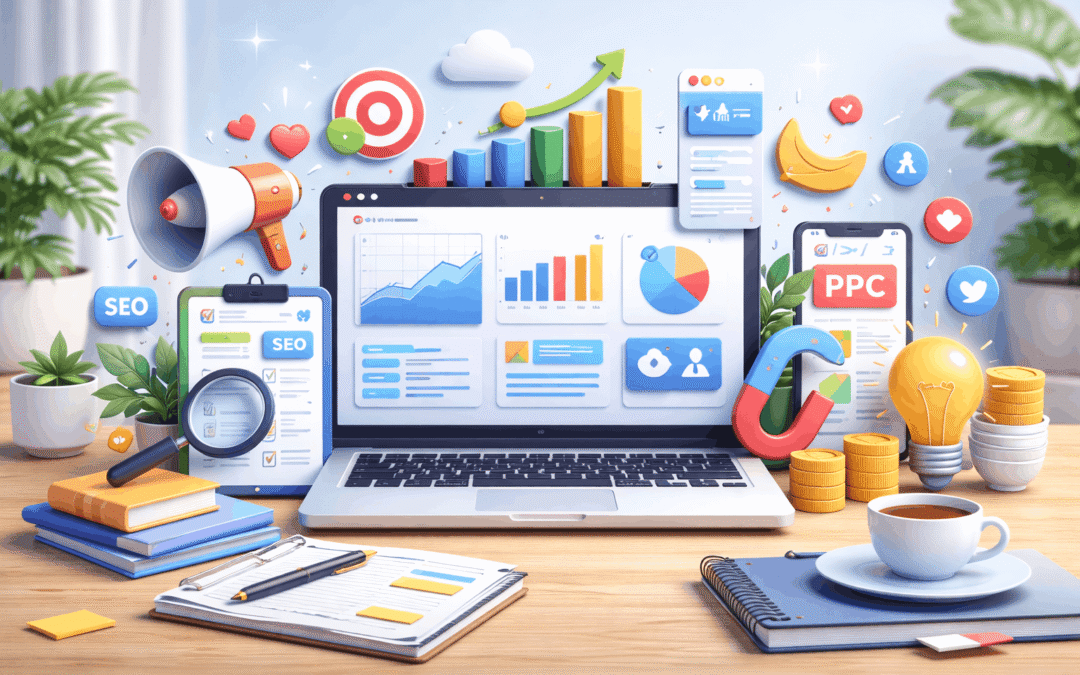
Digital Marketing refers to the use of online channels, platforms, and technologies to promote products and services to a targeted audience. It includes strategies like Search Engine Optimization (SEO), Social Media Marketing (SMM), Content Marketing, Email Marketing, and Paid Advertising.
Digital marketing has become essential because businesses can reach a global audience, measure performance in real time, and optimize campaigns effectively.
Core Components of Digital Marketing
1. Search Engine Optimization (SEO)
SEO stands for Search Engine Optimization, which is the process of improving a website’s visibility in search engine results like Google.
2. Search Engine Marketing (SEM)
SEM stands for Search Engine Marketing, which involves paid advertising on search engines such as Google Ads.
3. Social Media Marketing (SMM)
SMM stands for Social Media Marketing, which uses platforms like Facebook, Instagram, and LinkedIn to promote brands.
4. Content Marketing
Content marketing focuses on creating valuable content like blogs, videos, and infographics to attract and engage users.
5. Email Marketing
Email marketing is the process of sending targeted emails to customers to promote products or build relationships.
6. Pay-Per-Click (PPC)
PPC stands for Pay-Per-Click, a model where advertisers pay each time a user clicks their ad.
7. Affiliate Marketing
Affiliate marketing involves earning commissions by promoting other companies’ products.
8. Influencer Marketing
Influencer marketing uses individuals with large followings to promote products.
9. Analytics & Data
Digital marketing relies heavily on data analysis to track performance and optimize strategies.
Benefits of Digital Marketing
- Global reach and scalability
- Cost-effective compared to traditional marketing
- Measurable results using analytics tools
- Better targeting and personalization
- Real-time performance tracking
100 Digital Marketing Interview Questions & Answers
Basics
- What is Digital Marketing?
Digital Marketing is the promotion of products or services using digital channels such as websites, search engines, social media, email, and mobile apps. - What is SEO?
SEO stands for Search Engine Optimization, which improves a website’s visibility in organic search results. - What is SEM?
SEM stands for Search Engine Marketing, which involves paid strategies to appear in search engine results. - What is SMM?
SMM stands for Social Media Marketing, which uses social media platforms to promote brands and engage audiences. - What is PPC?
PPC stands for Pay-Per-Click, a model where advertisers pay for each click on their ads. - What is content marketing?
Content marketing involves creating valuable and relevant content to attract and retain customers. - What is email marketing?
Email marketing is a strategy of sending emails to promote products and maintain customer relationships. - What is a keyword?
A keyword is a term that users enter into search engines to find information. - What is organic traffic?
Organic traffic refers to visitors who come from unpaid search results. - What is paid traffic?
Paid traffic comes from advertisements such as Google Ads or social media ads.
Intermediate
- What is CTR?
CTR stands for Click-Through Rate, which measures the percentage of users who click on a link. - What is CPC?
CPC stands for Cost Per Click, which is the amount paid for each click in a PPC campaign. - What is CPA?
CPA stands for Cost Per Acquisition, which measures the cost of acquiring a customer. - What is ROI?
ROI stands for Return on Investment, which measures the profitability of a campaign. - What is bounce rate?
Bounce rate is the percentage of users who leave a website without interacting. - What is conversion rate?
Conversion rate is the percentage of users who complete a desired action. - What is Google Analytics?
Google Analytics is a tool used to track and analyze website traffic. - What is backlink?
A backlink is a link from one website to another, important for SEO. - What is domain authority?
Domain Authority is a metric that predicts how well a website will rank on search engines. - What is landing page?
A landing page is a webpage designed specifically to convert visitors into leads or customers.
Advanced
- What is technical SEO?
Technical SEO focuses on optimizing website structure, speed, and indexing. - What is on-page SEO?
On-page SEO involves optimizing content, meta tags, and internal links. - What is off-page SEO?
Off-page SEO involves backlinks and external signals to improve rankings. - What is schema markup?
Schema markup is structured data added to a website to help search engines understand content. - What is A/B testing?
A/B testing compares two versions of content to determine which performs better.
- What is impression?
An impression is the number of times an ad or content is displayed to users. - What is reach?
Reach refers to the total number of unique users who see your content. - What is engagement?
Engagement includes interactions such as likes, shares, comments, and clicks. - What is KPI?
KPI stands for Key Performance Indicator, which measures the success of a campaign. - What is funnel in marketing?
A marketing funnel represents the customer journey from awareness to conversion. - What is lead generation?
Lead generation is the process of attracting and capturing potential customers. - What is remarketing?
Remarketing targets users who have previously interacted with your website or ads. - What is display advertising?
Display advertising uses visual ads like banners on websites and apps. - What is native advertising?
Native advertising matches the content style of the platform where it appears. - What is influencer reach?
Influencer reach is the number of people who see content shared by influencers. - What is cost per mille (CPM)?
CPM stands for Cost Per Thousand Impressions, which measures cost per 1000 views. - What is quality score?
Quality Score is a metric used by Google Ads to measure ad relevance and performance. - What is ad rank?
Ad Rank determines the position of your ad in search results. - What is organic ranking?
Organic ranking is the position of a website in unpaid search results. - What is SERP?
SERP stands for Search Engine Results Page, which shows results for a query. - What is crawlability?
Crawlability refers to how easily search engines can access your website pages. - What is indexing?
Indexing is the process of storing web pages in a search engine database. - What is page speed?
Page speed is the time it takes for a webpage to load. - What is mobile optimization?
Mobile optimization ensures websites work properly on mobile devices. - What is responsive design?
Responsive design adapts website layout to different screen sizes. - What is duplicate content?
Duplicate content refers to identical content appearing on multiple URLs. - What is canonical URL?
A canonical URL tells search engines the preferred version of a page. - What is link building?
Link building is the process of acquiring backlinks to improve SEO. - What is anchor text?
Anchor text is the clickable text in a hyperlink. - What is social proof?
Social proof includes reviews and testimonials that influence customer trust. - What is conversion funnel?
A conversion funnel shows steps users take before completing a goal. - What is churn rate?
Churn rate is the percentage of customers who stop using a service. - What is customer lifetime value (CLV)?
CLV stands for Customer Lifetime Value, which estimates total revenue from a customer. - What is personalization?
Personalization tailors content based on user behavior and preferences. - What is automation?
Automation uses tools to perform marketing tasks automatically. - What is drip campaign?
A drip campaign is a series of automated emails sent over time. - What is segmentation?
Segmentation divides audiences into groups based on characteristics. - What is retargeting pixel?
A retargeting pixel tracks user behavior for remarketing ads. - What is brand awareness?
Brand awareness measures how well people recognize a brand. - What is traffic source?
Traffic source indicates where website visitors come from. - What is referral traffic?
Referral traffic comes from links on other websites. - What is direct traffic?
Direct traffic comes from users entering the URL directly. - What is organic vs paid traffic?
Organic traffic is free from search engines, while paid traffic comes from ads. - What is content strategy?
Content strategy plans creation and distribution of content. - What is storytelling in marketing?
Storytelling uses narratives to connect emotionally with audiences. - What is video marketing?
Video marketing uses videos to promote products or services. - What is viral marketing?
Viral marketing spreads content rapidly through sharing. - What is growth hacking?
Growth hacking uses creative strategies for rapid growth. - What is influencer ROI?
Influencer ROI measures return from influencer campaigns. - What is affiliate link?
An affiliate link tracks sales generated by partners. - What is conversion tracking?
Conversion tracking measures actions taken after clicking ads. - What is heatmap?
A heatmap shows where users click or interact on a page. - What is user experience (UX)?
UX stands for User Experience, focusing on usability and satisfaction. - What is user interface (UI)?
UI stands for User Interface, which deals with design and layout. - What is CRO?
CRO stands for Conversion Rate Optimization, improving conversions. - What is attribution model?
An attribution model assigns credit to marketing channels. - What is multi-channel marketing?
Multi-channel marketing uses multiple platforms to reach users. - What is omnichannel marketing?
Omnichannel marketing provides a seamless user experience across channels. - What is lead nurturing?
Lead nurturing builds relationships with potential customers over time. - What is customer journey?
Customer journey maps the full experience from awareness to purchase. - What is ad copy?
Ad copy is the text used in advertisements. - What is headline optimization?
Headline optimization improves click-through rates. - What is click fraud?
Click fraud involves fake clicks to waste ad budget. - What is negative keyword?
Negative keywords prevent ads from showing for unwanted searches. - What is geo-targeting?
Geo-targeting shows ads to users in specific locations. - What is device targeting?
Device targeting shows ads based on device type. - What is frequency capping?
Frequency capping limits how often users see ads. - What is programmatic advertising?
Programmatic advertising uses automation to buy ads. - What is demand generation?
Demand generation creates interest in products or services. - What is inbound marketing?
Inbound marketing attracts customers through valuable content. - What is outbound marketing?
Outbound marketing pushes messages to a broad audience. - What is marketing mix?
Marketing mix includes Product, Price, Place, and Promotion (4Ps). - What is branding?
Branding creates a unique identity for a business. - What is positioning?
Positioning defines how a brand is perceived in the market. - What is competitor analysis?
Competitor analysis studies competitors’ strategies. - What is SWOT analysis?
SWOT stands for Strengths, Weaknesses, Opportunities, and Threats. - What is digital strategy?
Digital strategy is a plan to achieve marketing goals online. - What is marketing automation tool?
A marketing automation tool automates campaigns and workflows. - What is KPI tracking?
KPI tracking monitors key metrics for performance evaluation. - What is digital marketing plan?
A digital marketing plan outlines strategies, goals, and execution steps.
Tricky Follow-Up Questions
- Can SEO guarantee rankings?
- Which is better: SEO or PPC?
- How to reduce bounce rate effectively?
- Can paid ads harm SEO?
- What is the biggest mistake in digital marketing?
Conclusion
Digital marketing is a powerful field that combines creativity, analytics, and strategy. Mastering its fundamentals and preparing for interview questions can help you build a successful career in this domain.